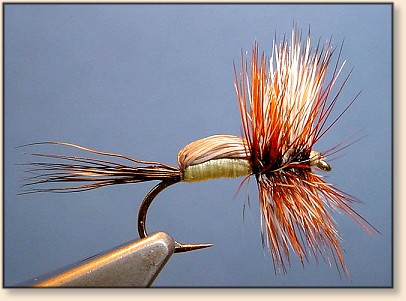
The Taylors shrimp is one of the first flies I learned how to tie. It is very effective especially in water there scud and fresh water shrimp can be found. I also know a fisherman who ties this pattern on larger hooks for steel head and Salmon on the Columbia River and in fishing ocean bays. As the creator is Marv Taylor I give all the credit to him and this past month I got the story on how he developed the pattern. Marv was fishing a tex favorite on Horsethief Reservoir for a couple of days. he tried other patterns but found the tex to be the most effective. After some more research Marv discovered the fish where taking the Tex favorite as a scud. SO he tied this up with some materials he had with him and it worked even better than the Tex. You will notice that it is tied on a curved hook but as Marv explains you need some on curved to simulate swimming scud and some on straight hooks to show the scud in a resting state. Fish it Deep!!!! that where the scud hang out. This fly is easy to tie in fact of you can tie a Woolly Bugger you can tie the Taylors Shrimp. Colors: yellow and black variegated is best but I have found an olive and black chenille with a sparkle that I think works even better. Don't tell Marv! Also pale light yellow or light pink, natural Orange and very light tan and even a light off white or cream.
Hook: Regular shank (at rest) 8 - 14, weighted with .020 fuse wire; Standard 1X long (swimming) 8 - 14, also weighted.
Thread: Light olive, prewaxed 6/0.
Tail: Light-olive saddle hackle, tied on by the butt, half way down the bend.
Body: Dark-olive and gold (Dark-olive and yellow will work) variegated chenille, size small (Danvilles 0 size) tied halfway down the bend, and wrapped forward.
Legs: Light-olive saddle hackle, tied on at the bend and wrapped forward over the chenille, and trimmed on the top and on the sides.
HEAD: Light olive.
Thursday, February 10, 2011
Wednesday, February 09, 2011
Where did I go?
Sorry all been busy with School and work. Updates will be coming very soon!
Published with Blogger-droid v1.6.7
Wednesday, January 19, 2011
Me and Marv
Marv Taylor and I at the Western Idaho Flyfishing Expo last weekend. Marv is some what of a stillwater pioneer and local legend. He wrote the outdoor column for the Idaho statesman for a number of years and published 7 books dealing with fishing and entomology. I personally have learned a great deal from his literature and he is some what of a hero of mine. He develop a number of flies that I use and tie and was instrumental in helping to popularize many of his peers work in fly tieing and fishing. Marv is now 84 years old and "going strong" according to his statement. He is currently spending his time traveling to shows and conclaves around the west and doing a bit of fishing when he can.......go figure. More on Marv his flies and stories to follow later.
Published with Blogger-droid v1.6.5
Tuesday, January 18, 2011
Boise Valley Woolly Buggers
Tonight I took Rose and Caleb to there first meeting with the Boise Valley Woolly Buggers.The Boise Valley Woolly Buggers is a young oriented fly fishing club that I have been interested in for quit some time. They teach the kids fly fishing skills, fly tying, and conservation. There motto is "There is more to fishing than catching fish". The youth lead the meetings with adult supervision. The group was start by Boise native and fly fishing legend Clayne Baker whom I first met while fishing out on Warm Lake a few years ago. Clayne's hope is that the youth involved learn about leadership and being a team player. Tonights meetings the kids had an art contest and had to create there own picture of a fish. The winner won a small box of flies that had been provided by one of the fathers. The meeting also featured an inclusive update on area fishing trends and techniques to use in winter weather. The kids also shared fishing stories with each other and at the end had a door prize drawing. Caleb won a large sack full of fly tying materials and drew a second time and won some flies. Rose also won a large sack of tying materials. Both of my kids showed excited attitude before during and after the meeting, in fact they were dang near impossible to get to bed! As a father I am excited to see them interested as much as they are and look forward to more meetings. Our next goal is waiting for a decent day to try out a pond recommended by Clayne to catch some bluegill. Probably try some small midge dry fly patterns or tiny chironomid nymph patterns. My over all impressions of the meeting: The kids ran the whole meeting and all the kids were attentive and non-disruptive. Everyone seemed to enjoy themselves even the adults who kind of watched while sitting at the back of the room or conversing in the hall way while the kids carried on with the meeting. The youth leaders seemed to be conscience and appreciative and complimented each kid as they presented stories, pictures, and came up to accept prizes. I was thoroughly impressed at how well the meeting ran and look forward to seeing my ids participate in a fantastic organization.
Wednesday, January 12, 2011
Fly of the Week: Humpy
The Humpy is a good all around attractor pattern. It can be tied in any color. Some people tie it with a very slim body. Not me, I say if you want a slim bodied, high floater, use a Wulff. Humpys should be big and fat. They float like a cork. They work very well in the summer and fall as they imitate a number of terrestrials. They are also a good searching pattern when no hatch is evident. Generally, it is fished dead drift. But, sometimes I like to use the Humpy as an indicator when fishing small emergers or midges in rougher water and a dropper nymph.
The important thing to remember about this fly is that it is a pattern so you should tie it in a wide variety of sizes and colors. My advice go out to where you are fishing and simply copy color combinations that you see! Good Luck and tight lines.
Materials:
Thread: 8/0, to match body color
Hook: dry fly sizes 10 to 18
Tail: Moose.
Body: Thread.
Overbody and wing: Elk cow.
Hackle: Silver Saddle, furnace and grizzly.
Tying Instructions: Humpy
1. Start the thread halfway at the hook shank. This is important, as it is the reference point for the body. Wrap to the bend, tie in tail, wrap to halfway point. (*You can use 6/0, but I've found that 8/0, because of its smaller diameter, "bites" into the material better than 6/0.)
2. Take a bunch of Elk, remove all underfur, stack well, size (correct size is from tip of the tail to hook eye), and cut to length.
3. Tie the Elk to the hook, wrap towards the bend, keeping the Elk on top of the hook. Wrap until you've completely covered the thread wraps for the tail. Never mind the stubs at the tie-in point - they will disappear later on.
4. Wrap the underbody with thread. Pray that it doesn't break, which happened to me... Lift the Elk, give it a quarter turn, fold it over and tie down on top of the hook shank. This should be at the halfway point. After three thread wraps I lift the wing and put two wraps under the wing around the shank, then three wraps over the wing again. I finish with one wrap around the shank only.
5. Divide the wing, put thread wraps around the base of each wing, post the wings. Lay a thread foundation in front of the wing, making a smooth taper towards the eye. Without this thread foundation the hackle will be all over the place due to the big difference in diameter behind and in front of the wing.
6. Tie in the hackle(s), dull side facing forward. Don't tie the hackle down where the barbs start; leave a short length of bare stem, which will produce a cleaner start of the hackled collar. The ugly spot, where the thread broke, will be covered with the first wrap of the furnace hackle.
7. Palmer the hackles forward, starting with the hackle that was tied in last (here: the grizzly one). Tie off hackles and whip finish.
The important thing to remember about this fly is that it is a pattern so you should tie it in a wide variety of sizes and colors. My advice go out to where you are fishing and simply copy color combinations that you see! Good Luck and tight lines.
Materials:
Thread: 8/0, to match body color
Hook: dry fly sizes 10 to 18
Tail: Moose.
Body: Thread.
Overbody and wing: Elk cow.
Hackle: Silver Saddle, furnace and grizzly.
Tying Instructions: Humpy
1. Start the thread halfway at the hook shank. This is important, as it is the reference point for the body. Wrap to the bend, tie in tail, wrap to halfway point. (*You can use 6/0, but I've found that 8/0, because of its smaller diameter, "bites" into the material better than 6/0.)
2. Take a bunch of Elk, remove all underfur, stack well, size (correct size is from tip of the tail to hook eye), and cut to length.
3. Tie the Elk to the hook, wrap towards the bend, keeping the Elk on top of the hook. Wrap until you've completely covered the thread wraps for the tail. Never mind the stubs at the tie-in point - they will disappear later on.
4. Wrap the underbody with thread. Pray that it doesn't break, which happened to me... Lift the Elk, give it a quarter turn, fold it over and tie down on top of the hook shank. This should be at the halfway point. After three thread wraps I lift the wing and put two wraps under the wing around the shank, then three wraps over the wing again. I finish with one wrap around the shank only.
5. Divide the wing, put thread wraps around the base of each wing, post the wings. Lay a thread foundation in front of the wing, making a smooth taper towards the eye. Without this thread foundation the hackle will be all over the place due to the big difference in diameter behind and in front of the wing.
6. Tie in the hackle(s), dull side facing forward. Don't tie the hackle down where the barbs start; leave a short length of bare stem, which will produce a cleaner start of the hackled collar. The ugly spot, where the thread broke, will be covered with the first wrap of the furnace hackle.
7. Palmer the hackles forward, starting with the hackle that was tied in last (here: the grizzly one). Tie off hackles and whip finish.
Tuesday, January 11, 2011
We need a little history to make sense of fly rod actions. The first so-called fly rods were wood, and pretty crude. Fly lines were braided horse hair, not very effective either. Eventually rods evolved to cane, then split cane into intricately designed casting tools. Works of art - then and now.Split bamboo soon became the ultimate fly rod and still today is used by traditionalists and collectors.
During World War II, many new products hit the market. Fiberglass was one of them. So was PVC. Dacron and Nylon came out of the war effort too. Lots of innovations that ended up in the fly fishing world.
Fiberglass fabric was wrapped on a wood rod. Epoxy finished and the fiberglass rod was on the market. When the inventors figured out how to do away with the wood center the first hollow rods were born.
Considering the choices available at the time, either split bamboo or steel, the fiberglass rods were designed to copy bamboo. Fake bamboo rods. With a similar action ... as close as possible. Cane fly rods have a soft to moderate action. Some fiberglass rods were very soft and often referred to as "noodley" and the longer the rod, the more noodley it became.
Follow through a couple more decades into the space age and we find the fly rod industry taking advantage of new technology again. This time it is graphite and boron. Almost any material can be formed into threads of some sort. Once it's thread, it can be woven into fabric ... just like fiberglass which appeared in drapes, patching material for cars and boats - and flyrods. Boron was tried and rejected because it was considerably heavier than graphite without additional strength.
Here comes the catch. Those companies who had been making fiberglass rods had everything set up to make those rods to imitate or at least be similar to bamboo. Now there is a new material. What will happen?
Most companies had their machinery, mandrills (steel forms the fabric is wrapped on to make the blanks,) and their reputations established. If you bought one of their rods you knew by reputation how the rod would feel.
Some companies replaced part of the threads in the fabric with graphite. That made the rods lighter, but only slightly changed the action.
New companies had the option to make the same slow or medium action rods already on the market - or to do something entirely different. That's where faster action rods started.
Fast rods that are lighter in your hand, use more of the tip to propel the line, and (if cast correctly) do the work for you. One of the major advantages in fast rods is the person casting it does less work. So you aren't as tired as quickly.
Fast rods are primarily designed with the butt and middle sections built to play the fish, the top one third to cast the line. That does make the tip section (which is tiny compared to rods just a few years ago) vulnerable to breakage if the rod is used incorrectly when playing or landing a fish.
Bottom line? What do you want to fish for? Under what conditions? What can you afford? If you are casting well enough to get the fly where you want it most of the time, you also probably have developed a style - a method that is comfortable for you.
From one who has been fishing for some years, a word of encouragement. There is no such thing as a bad graphite fly rod. All of us would have thought we had gone to heaven if we had been offered any of the rods on the market today 25 years ago. The fly rod industry has made giant leaps improving our sport.
Match the action of the rod, and the price, to what works for you. Final word of wisdom: Don't ever buy a rod you have not cast.
During World War II, many new products hit the market. Fiberglass was one of them. So was PVC. Dacron and Nylon came out of the war effort too. Lots of innovations that ended up in the fly fishing world.
Fiberglass fabric was wrapped on a wood rod. Epoxy finished and the fiberglass rod was on the market. When the inventors figured out how to do away with the wood center the first hollow rods were born.
Considering the choices available at the time, either split bamboo or steel, the fiberglass rods were designed to copy bamboo. Fake bamboo rods. With a similar action ... as close as possible. Cane fly rods have a soft to moderate action. Some fiberglass rods were very soft and often referred to as "noodley" and the longer the rod, the more noodley it became.
Follow through a couple more decades into the space age and we find the fly rod industry taking advantage of new technology again. This time it is graphite and boron. Almost any material can be formed into threads of some sort. Once it's thread, it can be woven into fabric ... just like fiberglass which appeared in drapes, patching material for cars and boats - and flyrods. Boron was tried and rejected because it was considerably heavier than graphite without additional strength.
Here comes the catch. Those companies who had been making fiberglass rods had everything set up to make those rods to imitate or at least be similar to bamboo. Now there is a new material. What will happen?
Most companies had their machinery, mandrills (steel forms the fabric is wrapped on to make the blanks,) and their reputations established. If you bought one of their rods you knew by reputation how the rod would feel.
Some companies replaced part of the threads in the fabric with graphite. That made the rods lighter, but only slightly changed the action.
New companies had the option to make the same slow or medium action rods already on the market - or to do something entirely different. That's where faster action rods started.
Fast rods that are lighter in your hand, use more of the tip to propel the line, and (if cast correctly) do the work for you. One of the major advantages in fast rods is the person casting it does less work. So you aren't as tired as quickly.
Fast rods are primarily designed with the butt and middle sections built to play the fish, the top one third to cast the line. That does make the tip section (which is tiny compared to rods just a few years ago) vulnerable to breakage if the rod is used incorrectly when playing or landing a fish.
Bottom line? What do you want to fish for? Under what conditions? What can you afford? If you are casting well enough to get the fly where you want it most of the time, you also probably have developed a style - a method that is comfortable for you.
From one who has been fishing for some years, a word of encouragement. There is no such thing as a bad graphite fly rod. All of us would have thought we had gone to heaven if we had been offered any of the rods on the market today 25 years ago. The fly rod industry has made giant leaps improving our sport.
Match the action of the rod, and the price, to what works for you. Final word of wisdom: Don't ever buy a rod you have not cast.
Western Idaho Fly Fishing Expo
This will be the Boise Valley Fly Fishermen's 40th year since its conception and this will be our 7th annual expo. Our mission to promote the sport of fly-fishing through education and conservation activities is dependent upon a successful Expo.
Instruction in fly tying, casting, and fly fishing ethics has been our strength over the years. This year's event will feature several new programs as well as workshops in these areas.
This is a gathering that will allow Idaho and other regional fly tiers to show their talents to the fly-fishing public and exchange ideas, new and old.
Saturday evening, there will be a banquet with a program, dinner, raffle and auction. The Boise Valley Fly Fishermen will earmark funds raised at this event for various regional conservation undertakings.
We've nearly doubled the size Expo Hall,and have a large number of fly tiers who are listed on our tiers page. You'll see demos from high floating dry flies to deep sinking nymphs and tiers that will show you techniques that are guaranteed to make your fly tying and fishing more rewarding.
Instruction in fly tying, casting, and fly fishing ethics has been our strength over the years. This year's event will feature several new programs as well as workshops in these areas.
This is a gathering that will allow Idaho and other regional fly tiers to show their talents to the fly-fishing public and exchange ideas, new and old.
Saturday evening, there will be a banquet with a program, dinner, raffle and auction. The Boise Valley Fly Fishermen will earmark funds raised at this event for various regional conservation undertakings.
We've nearly doubled the size Expo Hall,and have a large number of fly tiers who are listed on our tiers page. You'll see demos from high floating dry flies to deep sinking nymphs and tiers that will show you techniques that are guaranteed to make your fly tying and fishing more rewarding.
Subscribe to:
Posts (Atom)